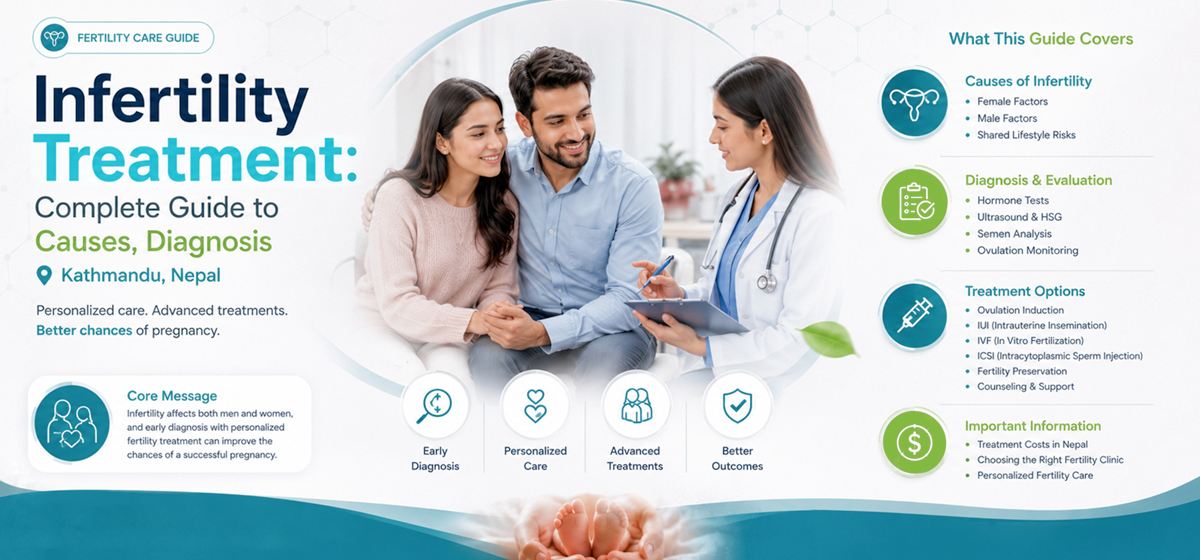
Infertility Treatment: Complete Guide, Causes, and Diagnosis
Key Takeaways
- Infertility is defined as the inability to conceive after 12 months of regular, unprotected intercourse, or 6 months if the woman is over 35.
- Globally, an estimated 60 million couples are affected by infertility, with the majority in developing countries where access to diagnosis is limited.
- Causes are roughly split between female factors, male factors, combined factors, and unexplained infertility — it's rarely just one partner's issue.
- Treatment in Kathmandu ranges from ovulation induction and IUI to IVF and ICSI, chosen based on the specific cause identified through testing.
Trying to conceive without success can feel isolating, especially when everyone around you seems to be moving forward with their families. If you've been trying for over a year without a positive result, you're not alone, and you're not without options. Infertility treatment in Kathmandu has advanced significantly over the past decade, with modern diagnostic tools and treatment protocols now available right here at home, without the need to travel abroad.
This guide walks through what infertility actually means, what causes it in both men and women, how it's diagnosed, what treatment looks like, and what it costs for couples in Kathmandu today.
What Is Infertility?
Infertility is generally diagnosed when a couple fails to conceive despite regular, unprotected intercourse for more than 12 months. It doesn't always mean one partner is "at fault." Infertility can stem from either partner's inability to contribute to conception or from difficulty carrying a pregnancy to term.
It's also more common than most people realize. Worldwide, roughly 60 million couples are affected by infertility, and a large share of those cases come from developing countries, where access to timely diagnosis and treatment is often limited. That's part of why local, accessible infertility treatment in Kathmandu has become so important for Nepali couples — it removes the barrier of having to travel abroad for basic diagnostic care.
Lifestyle factors play a larger role than many people realize. Obesity, chronic stress, delayed childbearing, and regular smoking or drinking can all contribute to infertility, whether it's a first pregnancy or a subsequent one. None of these guarantees infertility on its own, but together they raise the risk considerably, which is why fertility specialists ask about lifestyle history just as closely as medical history.
Causes of Infertility in Women
Female infertility can stem from a number of structural, hormonal, or age-related issues, including:
- Pelvic surgery, infection, or appendicitis: scarring from past procedures or infections can affect the reproductive organs.
- Early menopause before age 40: reduces the number of viable eggs available for conception.
- Inflammation of the fallopian tubes can block the path that eggs need to travel to reach the uterus.
- Thyroid disorders, irregular menstrual cycles, eating disorders, and excessive exercise are all factors that disrupt normal hormonal balance and ovulation.
- PMOS (formerly known as PCOS): one of the leading causes of female infertility, disrupting ovulation through hormonal imbalance.
- Reproductive cancers, radiation, and chemotherapy: treatments that can damage reproductive tissue or reduce egg reserve.
- Endometriosis: where endometrial tissue grows outside the uterus, often causing pain and fertility complications.
- Tumors or cervical abnormalities: structural issues that interfere with implantation or conception.
Causes of Infertility in Men
Male infertility is just as common as female infertility, though it's discussed far less openly. Male-factor issues are typically identified through semen analysis and hormone testing, and can include low sperm count, poor sperm motility, or structural issues affecting sperm production and delivery, such as varicocele.
Shared Risk Factors Between Men and Women
Several risk factors affect fertility in both partners, though the way they manifest differs by sex:
- Weight: an inactive lifestyle, poor diet, or restrictive low-calorie eating increases the difficulty of conceiving in women. In men, being overweight is directly linked to lower sperm counts.
- Age: women over 37 tend to produce lower-quality eggs, making conception harder. Men also see a decline in fertility after age 40, though the drop tends to be more gradual.
- Tobacco and alcohol use: in women, tobacco use reduces the likelihood of pregnancy, and alcohol use is directly linked to infertility diagnoses. In men, both habits are associated with a higher risk of erectile dysfunction and reduced sperm motility.
Understanding these shared risk factors is often the first step toward an effective diagnosis, since a specialist will typically evaluate both partners together rather than treating the issue as belonging to just one person.
Infertility Diagnosis and Testing
Roughly 1 in 10 couples experience trouble conceiving, so if you've been trying for over a year, the right next step is a consultation with a fertility specialist rather than months of uncertainty on your own.
Diagnostic Tests for Men
A semen analysis measures sperm count, morphology (shape), and motility (movement). Blood tests evaluate testosterone and other relevant hormone levels.
Diagnostic Tests for Women
| Test | What It Checks |
|---|---|
| Ovulation test | A blood test to confirm regular, egg-producing cycles |
| Ultrasound scan | Uterine lining, polyps, fibroids, ovarian cysts, and follicle activity |
| Anti-Müllerian Hormone (AMH) test | Estimates egg count, also known as ovarian reserve testing |
| Hysterosalpingography (HSG) | Checks for blockages or abnormalities in the fallopian tubes |
Shared or Advanced Diagnostic Tests
Genetic blood testing screens for conditions such as Cystic Fibrosis, FSH receptor issues in women, AZF in men, and MTHFR, which can affect fertility. A biopsy, a minor procedure under local anesthesia, can obtain tissue samples for further evaluation, and venography is used to identify possible blockages in the reproductive tubes.
If you're unsure where to begin, it's worth reading more about the diagnostic and treatment services offered by National IVF before your first visit, so you know what to expect.
Ready to Find Out What's Really Going On?
Our fertility specialists provide complete diagnostic evaluations for both partners, so you get real answers instead of more months of guessing.
Book Your Free ConsultationInfertility Treatment Options in Kathmandu
Once a diagnosis is made, treatment is tailored to the specific cause and the couple's circumstances:
Medication and Ovulation Induction
Often, the first step for women with ovulation-related issues is using medications like letrozole or clomiphene to stimulate egg release.
Intrauterine Insemination (IUI)
A less invasive procedure where prepared sperm is placed directly into the uterus around ovulation, often tried for 3 to 4 cycles for mild male factor or unexplained infertility. Learn more about IUI treatment at National IVF.
IVF and ICSI
Recommended for more complex cases, including tubal blockages, low sperm count, or unexplained infertility. Eggs are retrieved, fertilized in a lab (with a single sperm injected directly for ICSI), and the resulting embryo is transferred to the uterus. National IVF walks patients through exactly what the IVF process involves, from the first injection to embryo transfer.
Fertility Preservation
Egg or sperm freezing for couples who want to plan for the future, whether for medical reasons or personal timing.
Counseling and Emotional Support
An often-overlooked but essential part of the fertility journey, given how emotionally taxing this process can be for both partners.
Infertility Treatment Cost in Kathmandu
Cost depends heavily on the treatment type, number of cycles needed, and individual medication requirements. Overall, infertility treatment in Kathmandu ranges from NPR 10,000 to NPR 700,000, depending on the procedure, with IUI on the lower end and donor-egg IVF on the higher end. Get a personalized estimate during your first consultation, since medications and additional testing vary by patient.
Cost Breakdown by Treatment Type
| Treatment | Approximate Cost |
|---|---|
| IUI (Intrauterine Insemination) | NPR 10,000 – 30,000 per cycle |
| Standard IVF (self eggs and sperm) | NPR 2,80,000 – 5,00,000 per cycle (medications may be extra depending on the clinic package) |
| IVF with ICSI | NPR 3,50,000 – 5,50,000 |
| Frozen Embryo Transfer (FET) | NPR 75,000 – 1,50,000 |
| IVF with Donor Eggs | NPR 4,50,000 – 6,50,000 |
| IVF with Donor Sperm | NPR 3,50,000 – 4,50,000 |
| Surgical Sperm Retrieval (TESA/PESA/TESE) | NPR 40,000 – 70,000 extra |
Choosing a Fertility Clinic in Kathmandu
Not every clinic offers the same depth of diagnostic and treatment services, so it helps to look for a few specific things: a doctor with dedicated training in reproductive medicine, transparent communication about success rates and costs, and a clinic that treats both partners as part of the diagnostic process rather than focusing on just one.
National IVF Center, located at Jyoti Bhawan, 4th Floor, Kantipath, Jamal, Kathmandu, is led by Dr. Usha Karki, Clinical Director and Consultant in Reproductive Medicine, whose approach to patient care has shaped how National IVF evaluates and treats every couple who walks through the door. Diagnostic testing, ultrasound, and semen analysis are handled in-house, and if a more advanced path is needed, so are IUI, IVF, ICSI, and fertility preservation, all under the same care team from first consultation through to pregnancy.
If you're ready to take the next step, you can book an appointment directly with National IVF or reach the clinic at 01-5919189 / 9851326462, or via email at ncrh.ivf@gmail.com.
Why Choose National IVF Center?
- Experienced fertility specialists
- Advanced IVF laboratory
- Complete infertility diagnosis for both partners
- Personalized treatment plans
- IVF, IUI, and ICSI under one roof
- Transparent treatment costs
- Patient-centered care
Frequently Asked Questions
Q: How long should we try to conceive before seeing a doctor?
A: Most specialists recommend seeking evaluation after 12 months of regular, unprotected intercourse without success, or after 6 months if the woman is over 35.
Q: Is infertility more common in men or women?
A: Infertility is roughly split between partners. Female factors, male factors, combined factors, and unexplained causes each account for a meaningful share of cases. It's rarely accurate to assume the issue lies with only one partner.
Q: How much does infertility treatment cost in Kathmandu?
A: It depends on the treatment. IUI typically costs NPR 10,000 to 30,000 per cycle, while standard IVF ranges from NPR 2,80,000 to 5,00,000 per cycle. IVF with ICSI, donor eggs, or donor sperm costs more, and surgical sperm retrieval adds NPR 40,000 to 70,000. Get a personalized quote during your first consultation.
Q: What tests are done for male infertility?
A: The primary tests are semen analysis, checking sperm count, shape, and movement, and blood tests to evaluate hormone levels, including testosterone.
Q: What tests are done for female infertility?
A: Common tests include an ovulation blood test, pelvic ultrasound, AMH (egg count) test, ovarian reserve testing, and hysterosalpingography (HSG) to check the fallopian tubes.
Q: Can infertility be treated without IVF?
A: Yes. Many couples respond well to ovulation medication, lifestyle changes, or IUI, depending on the underlying cause. IVF is typically reserved for cases where these options aren't likely to succeed.
Take the First Step Toward Parenthood
National IVF provides comprehensive diagnosis and treatment for both partners under one roof, with transparent pricing at every step.
Schedule Your AppointmentFree, no-obligation consultation | Experienced fertility specialists
Connect with us: National IVF on Facebook | Dr. Usha Karki on Facebook
Medical Disclaimer: This article is for general informational purposes and is not a substitute for a personalized medical consultation. Costs mentioned are approximate and subject to change. For an accurate diagnosis and treatment plan, schedule a consultation with National IVF Center, Kathmandu.