Key Takeaways
- Irregular periods often indicate irregular or absent ovulation, which can make pregnancy more difficult.
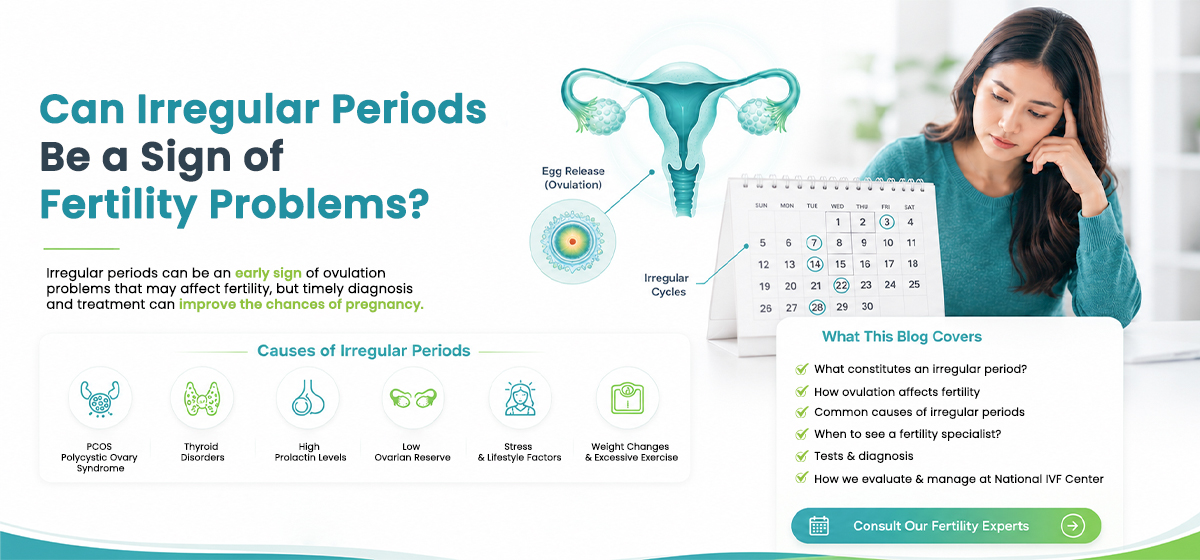
- Common causes include PCOS, thyroid disorders, high prolactin levels, ovarian reserve issues, stress, significant weight changes, and excessive exercise.
- Irregular periods do not automatically mean infertility; many women still conceive naturally.
- Early fertility evaluation helps identify the underlying cause and determine the most effective treatment.
Yes, irregular periods can affect fertility. They're often a visible sign that ovulation isn't happening on a predictable schedule, and without predictable ovulation, conceiving naturally becomes harder. But an irregular cycle is a symptom to investigate, not a diagnosis of infertility on its own. Below is what "irregular" means medically, why the connection to fertility exists, the most common causes, and when to see a specialist.
What Do Irregular Periods Mean?
A period is irregular if your cycle consistently falls outside 21–35 days, or if the length varies significantly month to month. A normal cycle is measured from the first day of one period to the first day of the next, and typically lasts 2–7 days.
Three patterns come up often in fertility evaluations:
- Oligomenorrhea — periods more than 35 days apart.
- Amenorrhea — no period for three or more consecutive months.
- Menorrhagia — periods that are unusually heavy or prolonged.
Do Irregular Periods Affect Fertility?
Yes, but through ovulation, not directly. Your period is the end result of a hormonal cycle that normally releases one egg mid-cycle. When that hormonal signaling is disrupted, both your period and your ovulation are affected at the same time, which is why irregular periods often (not always) point to a fertility issue underneath them.
Why Irregular Cycles Often Mean Irregular Ovulation
Irregular cycles are frequently linked to anovulation, cycles in which no egg is released. Anovulation is one of the most common causes of female-factor infertility, and irregular periods are often its first visible sign. Ovulation tracking (basal body temperature, ovulation predictor kits, or cycle apps) turns this into usable data for a doctor to evaluate.
Irregular Periods Don't Always Mean Infertility
No, many women with irregular cycles conceive naturally, sometimes without any intervention. And a "regular" 28-day cycle doesn't guarantee ovulation is happening correctly either. Cycle regularity is one data point, not a verdict.
Common Causes of Irregular Periods That Affect Fertility
PCOS
PCOS is one of the most common causes of irregular periods and infertility in women. It's driven by a hormonal imbalance, often elevated androgens that disrupt regular ovulation. Many women with PCOS still conceive naturally, especially with weight management, ovulation-inducing medication, or lifestyle changes; others need IUI or IVF.
Thyroid Disorders
Both hypothyroidism and hyperthyroidism disrupt the hormonal signaling that regulates ovulation. Hypothyroidism can prevent ovulation and affect implantation; hyperthyroidism can make it harder to sustain a pregnancy even after conception. A TSH blood test usually identifies this early.
High Prolactin Levels
Elevated prolactin, the hormone responsible for milk production, can suppress ovulation entirely, causing irregular or absent periods. Causes range from certain medications to a small, usually benign pituitary growth.
Amenorrhea, Oligomenorrhea, and Ovarian Reserve
When periods stop or become very infrequent, primary ovarian insufficiency, a decline in ovarian function before age 40, is one cause worth ruling out. It means fewer, less predictable ovulations, not menopause itself.
Stress, Weight Changes, and Over-Exercising
The body can suppress ovulation in response to significant stress, rapid weight change, or intense training, a well-documented link between stress, weight, and fertility. This cause is often reversible: cycles frequently normalize once weight stabilizes, training intensity is adjusted, or stress is managed.
When to See a Fertility Specialist
See a specialist if any of the following apply:
- Cycles consistently shorter than 21 days or longer than 35 days.
- No period for three or more months (and you're not pregnant).
- You're under 35 and have been trying to conceive for over one year.
- You're 35 or older and have been trying to conceive for over six months.
- Irregular periods are accompanied by weight change, excess facial or body hair, acne, or pelvic pain.
For female infertility in Kathmandu, this is the point to get a full female fertility evaluation from a fertility specialist rather than treating the irregular cycle in isolation.
How Irregular Periods Are Diagnosed and Treated
Diagnosis starts with a hormone panel (thyroid function, prolactin, FSH, LH, AMH) and a pelvic ultrasound to check for cysts, fibroids, or PCOS. Ovulation tracking over one or two cycles adds context when bloodwork alone isn't conclusive.
Treatment depends on the underlying cause:
Hormonal or Lifestyle Correction
Treatment may include thyroid medication, prolactin-lowering medication, weight management, nutritional improvements, stress reduction, or lifestyle modifications, depending on the diagnosis.
Ovulation Induction
When ovulation isn't occurring regularly, fertility medications may be prescribed to stimulate predictable ovulation and improve the chances of natural conception or assisted treatment.
Intrauterine Insemination (IUI)
If ovulation induction alone isn't enough, IUI may be recommended to increase the likelihood of fertilization by placing prepared sperm directly into the uterus during ovulation.
In Vitro Fertilization (IVF)
IVF may be recommended when other treatments haven't been successful or when additional fertility factors such as blocked fallopian tubes, severe male infertility, or reduced ovarian reserve are involved.
How National IVF Center Approaches This
National IVF, located centrally at Kantipath, Jamal, Kathmandu, evaluates hormonal, ovulatory, and structural factors together before recommending treatment, the same evidence-based approach that has made it one of the top fertility centers in Kathmandu for couples dealing with irregular cycles.
What sets this apart for irregular-period cases specifically is that every stage of care sits under one roof. Hormone testing, semen analysis, ovulation induction, and IUI are handled in-house, and if a more advanced path is needed, so are IVF, ICSI, PGT, and surgical sperm retrieval. Patients don't have to be referred elsewhere as their diagnosis or treatment plan develops; the same fertility care team follows the case from the first hormone panel through to pregnancy.
The clinic is led by Dr. Usha Karki, Clinical Director, whose close monitoring and evidence-based approach have earned National IVF a 5-star rating across its Google reviews, with patients specifically highlighting clear counseling and a calm, modern clinic environment. For women navigating irregular periods, unexplained infertility, or working toward an IVF pregnancy after months of unpredictable cycles, having one experienced fertility specialist in Nepal oversee every stage is a meaningful part of why National IVF is regarded as one of the best fertility centers in Kathmandu to begin that evaluation.
Concerned About Irregular Periods and Fertility?
Our fertility specialists provide comprehensive hormone testing, ovulation assessment, ultrasound evaluation, and personalized treatment plans to help identify the cause of irregular cycles and improve your chances of pregnancy.
Book Your Free ConsultationFrequently Asked Questions
Q: Can irregular periods cause infertility?
A: They can be a sign of an underlying issue, such as PCOS, thyroid disease, or anovulation, that affects fertility. The irregularity is a symptom to investigate, not the cause itself.
Q: Can you get pregnant with irregular periods?
A: Yes. Many women with irregular cycles conceive naturally, sometimes with ovulation tracking to identify the fertile window. Others need medical support if a hormonal condition is behind the irregularity.
Q: What's the difference between amenorrhea and oligomenorrhea?
A: Amenorrhea is no period for three or more months. Oligomenorrhea is infrequent periods that occur more than 35 days apart. Both conditions are evaluated similarly during a fertility assessment.
Q: Does PCOS mean I can't conceive naturally?
A: No. Many women with PCOS conceive naturally without assistance, especially with lifestyle support or ovulation-inducing medication. Others benefit from IUI or IVF. PCOS changes the odds and timeline, not the possibility of pregnancy.
Q: How are irregular periods treated before starting IVF?
A: Treatment usually begins by correcting the underlying hormonal or lifestyle cause. Ovulation induction may also be recommended before IVF, helping improve the body's response to fertility treatment whenever possible.
Take the First Step Toward Understanding Your Fertility
If you're experiencing irregular periods while trying to conceive, our fertility specialists can identify the underlying cause and recommend the most effective treatment plan for your individual needs.
Schedule Your AppointmentFree, no-obligation consultation | Experienced fertility specialists
Medical Disclaimer: “This article is for general information and does not replace a personal medical evaluation. If you're experiencing irregular periods and trying to conceive, consult a fertility specialist for testing specific to your situation.”