by Dr. Usha Karki, Obstetrician and Gynecologist/ Fertility Specialist.
Key Takeaways
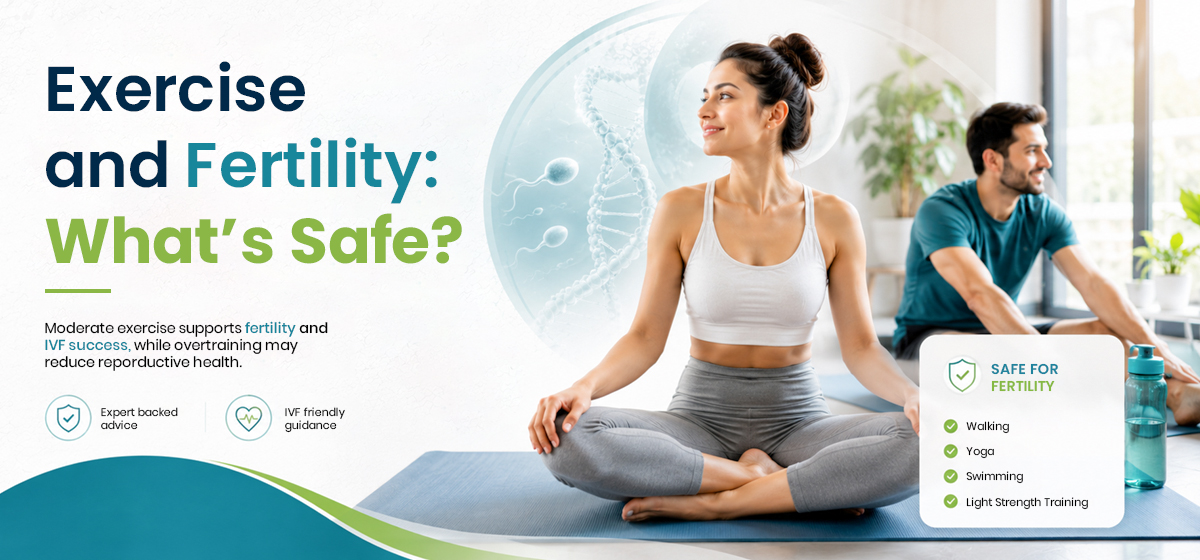
- Moderate exercise generally supports fertility, while both a sedentary lifestyle and extreme overtraining can work against you.
- During ovarian stimulation, switch to walking, gentle stretching, or restorative yoga, since enlarged ovaries carry a higher risk of ovarian torsion with high-impact movement.
- Walking is usually fine the day after egg retrieval, while more strenuous activity should wait three to five days depending on your recovery.
- Strict bed rest after embryo transfer isn't necessary. Gentle movement like walking is generally fine and often encouraged.
If you're trying to conceive, you've probably asked yourself the same question a hundred times: should I keep running, or should I stop moving altogether just to be safe? You're not alone. This is one of the most common concerns patients bring up in fertility consultations, and the honest answer is more nuanced than "more exercise is better" or "rest is always safer."
The short version: moderate exercise generally supports fertility, while both a sedentary lifestyle and extreme overtraining can work against you. In this guide, we'll break down exactly what "moderate" means, which workouts help, which ones to watch out for, and how your exercise routine might need to shift depending on your specific situation, whether that's trying to conceive naturally, going through IVF, or managing a condition like PCOS or endometriosis.
Benefits of Exercise for Fertility
Regular, moderate exercise supports fertility by improving hormonal balance, insulin sensitivity, and blood flow to your reproductive organs. It's one of the few fertility levers that's fully within your control.
Here's what's happening under the surface. Ovulation depends on a delicate feedback loop between your brain and ovaries, involving luteinizing hormone (LH) and follicle-stimulating hormone (FSH). Both hormones are sensitive to stress, energy availability, and body composition, and exercise influences all three.
Moderate activity improves insulin sensitivity, helps regulate cortisol (your primary stress hormone), and supports healthy circulation to the uterus and ovaries. Patients who move from a sedentary lifestyle to regular moderate exercise often see improvements in cycle regularity within a few months.
There's a mental health benefit too, and it's not a minor one. Fertility treatment is stressful, and consistent movement is one of the more reliable ways to manage that stress without medication. Lower stress levels are linked to better treatment outcomes, even if the exact mechanism is still being studied.
What does this mean for you practically? If you're currently inactive, adding light to moderate movement now, before you start treatment, can put your body in a better position going in.
Moderate vs. Intense Exercise
The line between helpful and harmful exercise comes down to intensity and volume, not the activity itself. Moderate exercise supports fertility. Exercise intense enough to disrupt your cycle can work against it.
Moderate exercise generally means activity where you can still hold a conversation: brisk walking, easy cycling, swimming at a relaxed pace, or a standard strength training session. This level of activity rarely interferes with ovulation and often improves it.
Intense exercise is a different story, particularly when it's frequent and combined with inadequate recovery or fueling. We often see this pattern in patients training for endurance events like marathons, or in those doing high-intensity programs such as CrossFit six or seven days a week without adequate rest. It's not that these activities are inherently harmful. The problem is the combination of high intensity, high frequency, and insufficient fuel, which can suppress the hormonal signals needed for ovulation.
Signs You've Crossed Into "Too Intense"
Watch for these signals, especially if you've recently increased your training load. If you're already noticing changes here, it's worth reading up on what irregular periods can mean for your fertility alongside these:
- Periods that have become irregular, unusually light, or have stopped
- A luteal phase (time between ovulation and your period) shorter than 10 days
- Ongoing fatigue that doesn't improve with rest
- Unintentional weight loss alongside intense training
- Frequent injuries or a sense your body isn't recovering between sessions
Have you noticed any of these changes since ramping up your training? That timing detail often tells us exactly what's going on.
Best Exercise Types
The best exercise for fertility is something you can do consistently at a moderate intensity, without pushing your body into constant physical stress. A few categories work particularly well.
Moderate cardio. Walking, swimming, and easy cycling support cardiovascular health and stress reduction without the hormonal disruption that comes with high-intensity endurance training.
Strength training. Resistance training two to three times a week improves insulin sensitivity, which matters a great deal if you're managing PCOS and its effect on fertility or dealing with any degree of insulin resistance. It also supports healthy body composition without the heavy caloric demands of long cardio sessions.
Low-impact, stress-reducing movement. Yoga and pilates offer a dual benefit: physical movement plus a measurable reduction in cortisol. Since chronic stress can itself interfere with ovulation, these are especially good options while you're actively trying to conceive or preparing for treatment.
Exercise During Stimulation
Once you start ovarian stimulation medications as part of your IVF cycle, your exercise routine needs to shift. This is one of the most important adjustments in the entire process, and it's not optional.
During stimulation, your ovaries enlarge significantly as multiple follicles develop at once, sometimes growing to several times their normal size. This makes them heavier and more prone to a serious complication called ovarian torsion, where the ovary twists on its supporting ligaments. High-impact movement, twisting motions, and anything involving sudden direction changes raise that risk.
Most fertility specialists recommend switching to walking, gentle stretching, or restorative yoga for the full duration of stimulation. Running, jumping, cycling on uneven terrain, contact sports, and heavy lifting are typically off the table until after retrieval. If you're unsure whether a specific activity is safe during your stimulation window, ask your care team directly rather than guessing.
Why This Matters More Than It Might Seem
Ovarian torsion is a medical emergency that can require surgery and, in some cases, loss of the ovary. It's rare, but the risk climbs specifically during stimulation because of ovarian size, which is exactly why this window gets stricter guidance than the rest of your fertility journey.
Post-Retrieval Activity
After egg retrieval, your body needs a short recovery window before returning to normal activity. Most patients can resume light movement within a few days, with full activity clearance typically coming after your next monitoring appointment.
Immediately after retrieval, your ovaries are still enlarged and the retrieval sites need time to heal. Walking is usually encouraged starting the day after the procedure, since gentle movement supports circulation and can ease bloating. Avoid anything high-impact, strenuous, or abdominally intense for at least three to five days, though your specific timeline depends on how many eggs were retrieved and how your ovaries respond afterward.
Watch for signs of ovarian hyperstimulation syndrome (OHSS), including significant bloating, abdominal pain, or rapid weight gain. If any of these appear, hold off on exercise entirely and contact your clinic, since OHSS changes the recovery timeline substantially.
Post-Transfer Restrictions
After embryo transfer, the guidance tightens again, though not as much as many patients expect. You don't need complete bed rest, but high-impact and high-intensity activity should wait.
Most clinics recommend avoiding heavy lifting, running, jumping, and any exercise that meaningfully raises your core body temperature or strains your abdominal muscles for at least the first week after transfer. Walking and light stretching are generally fine and often encouraged, since gentle movement supports blood flow without adding physical stress.
This is a common point of confusion: research on activity restriction after transfer hasn't shown that strict bed rest improves success rates, and in some cases, very limited movement is associated with worse outcomes. The goal isn't stillness. It's avoiding anything jarring or intense while your body focuses on implantation.
Your specific protocol may vary depending on your clinic and your individual case, so always follow the restrictions your care team gives you over general guidance you find elsewhere, including this article.
Duration and Frequency
How much exercise is appropriate depends heavily on where you are in your fertility journey, but general reproductive health guidelines offer a useful baseline outside of active treatment cycles.
Recommendations echoed by the American College of Obstetricians and Gynecologists (ACOG) suggest 150 minutes of moderate-intensity exercise per week, spread across most days rather than concentrated into one or two intense sessions. That works out to roughly 20 to 30 minutes a day.
During active treatment, that guidance shifts:
| Phase | Recommended Activity | Typical Duration |
|---|---|---|
| Pre-treatment / TTC | Moderate cardio, strength training | 150 min/week |
| Ovarian stimulation | Walking, gentle stretching only | 20-30 min/day |
| Post-retrieval | Walking, light movement | 3-5 days modified |
| Post-transfer | Walking, light stretching | 7+ days modified |
This table is a general reference, not a personal prescription. Your care team will adjust these windows based on your ovarian response, retrieval count, and individual health history.
Want to Know What Your Own Routine Should Look Like?
The team at National IVF Center can walk through your specific situation, bloodwork, and treatment plan to give you personalized guidance rather than generic rules.
Book Your ConsultationPersonal Exercise Plan
Because every fertility journey looks different, the most useful exercise plan is one built around your specific cycle, treatment stage, and health history rather than a generic template.
A few things worth bringing to your next appointment: your current activity level and workout types, any history of irregular cycles connected to training changes, and any conditions like PCOS or endometriosis that might change your ideal exercise mix. Your care team can then map out what's safe during each phase of your specific protocol.
What would it look like to build this into your treatment plan from the start, rather than adjusting on the fly once stimulation begins? Patients who plan their exercise routine alongside their treatment calendar tend to feel more in control of a process that otherwise involves a lot of waiting and uncertainty.
Why Choose National IVF Center?
National IVF Center, located at Jyoti Bhawan, 4th Floor, Kantipath, Jamal, Kathmandu, builds every IVF treatment plan around your full health picture, including activity level, before making any recommendations. Our doctors also share more everyday health tips for fertility worth browsing while you plan your next steps.
We're often asked what sets us apart as a fertility clinic in Kathmandu, and honestly, it comes down to exactly this kind of individualized planning rather than one-size-fits-all advice.
You can reach the clinic at 01-5919189 / 9851326462, by email at ncrh.ivf@gmail.com, or through the contact page.
Frequently Asked Questions
Q: Can I exercise during ovarian stimulation?
A: Light activity like walking and gentle stretching is generally safe, but high-impact exercise, running, and twisting movements should be avoided due to the risk of ovarian torsion from enlarged ovaries. Always confirm specific limits with your care team.
Q: When can I resume normal exercise after egg retrieval?
A: Most patients can start walking the day after retrieval, with full activity typically cleared after your follow-up monitoring appointment, usually within three to five days if there are no complications like OHSS.
Q: How long do I need to avoid exercise after embryo transfer?
A: Most clinics recommend avoiding heavy lifting, running, and high-intensity activity for at least the first week after transfer, while walking and light stretching are generally fine and often encouraged.
Q: Do I need bed rest after embryo transfer?
A: No, strict bed rest hasn't been shown to improve success rates and in some cases is linked to worse outcomes. Gentle movement is generally better than complete stillness.
Q: What's the best exercise for PCOS during fertility treatment?
A: A combination of regular strength training and moderate cardio tends to work best, since both improve insulin sensitivity, one of the key drivers of PCOS-related ovulation issues.
Q: How do I know if I've been exercising too intensely for fertility?
A: Watch for irregular or missed periods, a shortened luteal phase, persistent fatigue, or unintentional weight loss. Any of these alongside intense training is worth discussing with your doctor.
Q: Is yoga safe throughout the entire fertility treatment process?
A: Restorative or gentle yoga is generally safe throughout stimulation, post-retrieval, and post-transfer. Avoid hot yoga, deep twists, and inversions, since these add unnecessary strain during sensitive phases.
Ready for a Personalized Plan?
If you'd like a personalized plan based on your own health picture, National IVF Center can talk through what's right for your body and your goals.
Get in TouchConnect with us: National IVF on Facebook