Infertility Treatment in Nepal: A Complete Guide to Causes, Options, and Care
1 hour ago, 13 minutes read
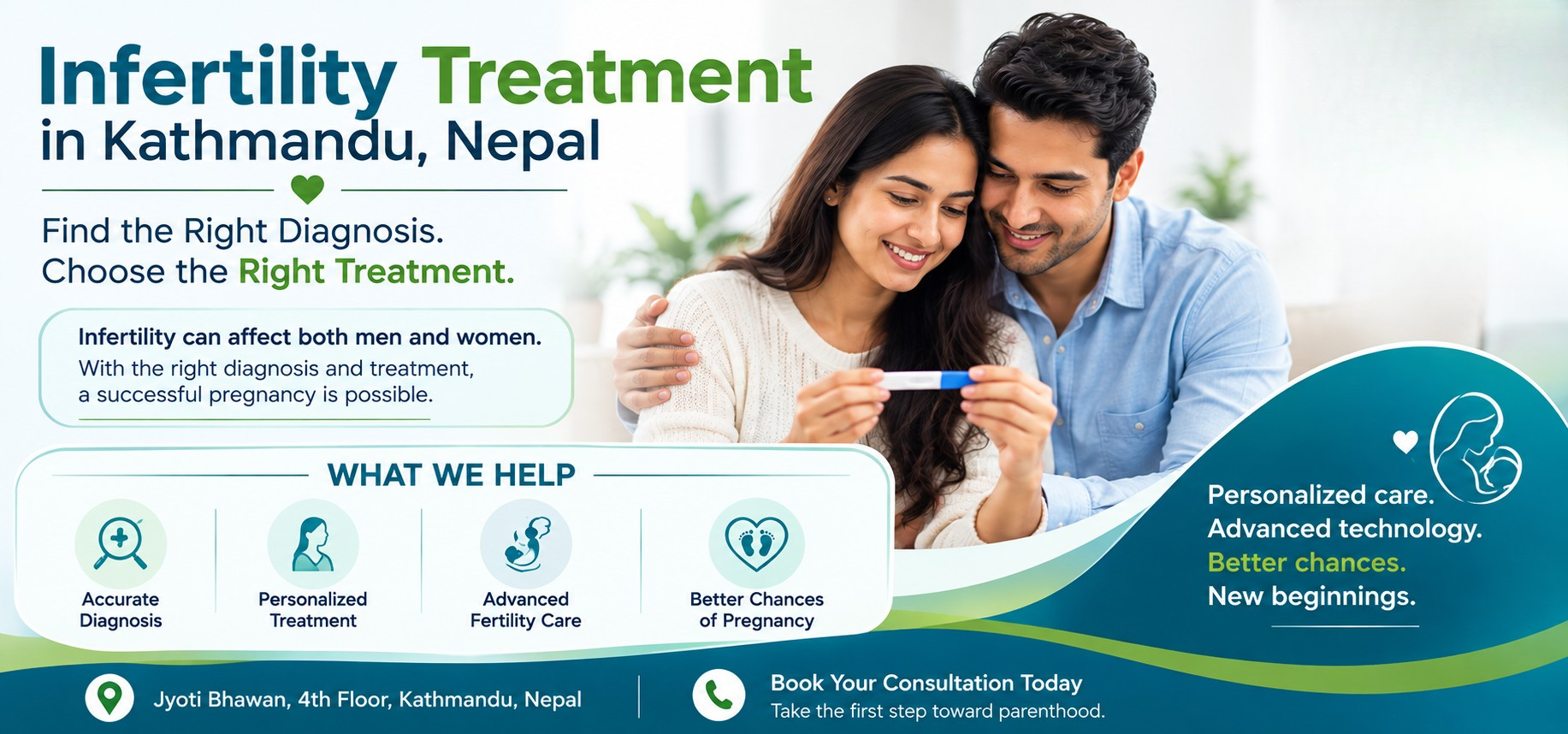
Navigating difficulties in conceiving can be an emotionally exhausting experience, especially when cultural pressures and medical uncertainties overlap. Today, infertility treatment in Nepal has advanced to match international clinical standards—offering couples everything from simple hormone regulation and ovulation tracking to state-of-the-art Assisted Reproductive Technology (ART) like IVF and ICSI right here in Kathmandu.
Contrary to common belief, visiting a fertility specialist does not mean you will immediately need In Vitro Fertilization (IVF). At National IVF (National Centre for Reproductive Health Pvt. Ltd.), led by Consultant Reproductive Medicine Specialist Dr. Usha Karki, treatment always begins with an accurate diagnosis. Many couples conceive through targeted lifestyle adjustments, medical ovulation induction, or Intrauterine Insemination (IUI) when the underlying cause is properly identified.
This guide explains the causes of infertility, the diagnostic evaluations required for both partners, the full spectrum of medical treatments available in Nepal, and how to choose the right path for your family.
Medically, infertility is defined as the inability to achieve a clinical pregnancy after 12 months of regular, unprotected intercourse for women under 35, or after 6 months for women aged 35 and older.
In Nepal, modern fertility clinics treat infertility using a stepped-care clinical framework:
First-Line Therapy: Addressing hormonal imbalances, thyroid or prolactin issues, and using oral medications for Ovulation Induction (OI) paired with ultrasound-guided timed intercourse.
Second-Line Therapy: Intrauterine Insemination (IUI), where washed, concentrated sperm is placed directly into the uterus around the time of ovulation, or minimally invasive surgery (hysteroscopy/laparoscopy) to correct structural barriers.
Third-Line Advanced ART: In Vitro Fertilization (IVF) and Intracytoplasmic Sperm Injection (ICSI) for blocked fallopian tubes, severe male factor infertility, diminished ovarian reserve, or when simpler treatments have not succeeded.
Fertility specialists categorize infertility into two main types:
Primary Infertility: When a couple has never achieved a pregnancy.
Secondary Infertility: When a couple has previously conceived (whether resulting in a live birth or miscarriage) but is now unable to conceive again.
Clinically, infertility is never solely a "woman’s issue." Global and local clinical data consistently show that approximately one-third of cases stem from female factors, one-third from male factors, and the remaining third from a combination of both partners or unexplained causes.
Ovulatory Disorders: Conditions that prevent regular egg release, most notably Polycystic Ovary Syndrome (PCOS), thyroid dysfunction, or hyperprolactinemia. Seeking specialized PCOS treatment in Nepal often restores natural ovulation without complex procedures.
Tubal Factor Infertility: Blocked, damaged, or scarred fallopian tubes—frequently caused by past pelvic infections, tuberculosis, or previous abdominal surgeries—which prevent the sperm from reaching the egg.
Endometriosis: A condition where tissue similar to the uterine lining grows outside the uterus, causing inflammation, scar tissue, and reduced egg quality.
Uterine Abnormalities: Fibroids, endometrial polyps, adenomyosis, or congenital uterine septums that interfere with embryo implantation.
Diminished Ovarian Reserve (DOR): A natural, age-related or premature decline in the quantity and chromosomal quality of eggs, particularly after age 35.
Abnormal Sperm Parameters: Low sperm concentration (oligozoospermia), poor forward movement (asthenozoospermia), or abnormal shape (teratozoospermia).
Azoospermia: The complete absence of measurable sperm in the ejaculate, caused either by a blockage in the reproductive tract (obstructive) or a failure in sperm production (non-obstructive).
Varicocele: Enlarged veins within the scrotum that raise testicular temperature and impair sperm production.
Lifestyle & Environmental Factors: Smoking, excessive alcohol intake, chronic heat exposure, and metabolic conditions. Learning how to improve sperm quality through targeted lifestyle and medical care is a vital part of treatment.
In roughly 10% to 15% of couples, standard diagnostic tests show normal ovulation, open fallopian tubes, a healthy uterine cavity, and normal semen parameters. This is termed unexplained infertility and often relates to subtle issues in egg-sperm interaction, embryo quality, or endometrial receptivity.
At National IVF, our core philosophy is diagnosis before intervention. Before recommending any treatment, both partners undergo a synchronized, evidence-based fertility evaluation:
For the Female Partner:
Hormonal Profile: Blood tests (typically on Day 2 or Day 3 of the menstrual cycle) to measure FSH, LH, Estradiol, TSH (Thyroid), and Prolactin.
Ovarian Reserve Testing: An Anti-Müllerian Hormone (AMH) blood test combined with a baseline transvaginal ultrasound to measure the Antral Follicle Count (AFC).
Tubal Patency Assessment: A Hysterosalpingography (HSG) or Saline Infusion Sonography (SIS) to confirm that the fallopian tubes are open and the uterine cavity is normal.
For the Male Partner:
Comprehensive Semen Analysis: Conducted after 2 to 5 days of abstinence to evaluate sperm volume, concentration, progressive motility, and morphology according to World Health Organization (WHO) guidelines.
Once your diagnostic profile is complete, Dr. Usha Karki designs a personalized treatment roadmap tailored to your biology, age, and duration of infertility.
For women with irregular cycles or anovulation (such as PCOS) who have open fallopian tubes and a partner with normal sperm parameters, Ovulation Induction is the first line of care. Oral medications (like Letrozole or Clomiphene Citrate) or low-dose hormonal injections are used to stimulate the development of a mature egg. Serial ultrasound scans (follicular monitoring) track the egg's growth so the doctor can advise the exact window for timed intercourse.
IUI is a simple, painless office procedure often recommended for mild male factor infertility, cervical mucus issues, or unexplained infertility.
How it works: Around the time of natural or medicated ovulation, the male partner provides a semen sample. The embryology lab washes and concentrates the sample to isolate the most active, healthy sperm. Using a thin, soft catheter, the specialist places these sperm directly into the uterine cavity, shortening the distance they must travel to reach the egg.
Sometimes structural barriers prevent pregnancy.
Diagnostic and Operative Hysteroscopy: A tiny camera is passed through the cervix to inspect the inside of the uterus and remove polyps, submucous fibroids, scar tissue (adhesions), or uterine septums that block embryo implantation.
Laparoscopy: A keyhole procedure used to treat endometriosis, remove ovarian cysts, or clear pelvic adhesions.
When fallopian tubes are blocked, endometriosis is severe, ovarian reserve is low, or several cycles of IUI have not succeeded, IVF offers the highest probability of pregnancy per cycle. During the step-by-step IVF process in Nepal, the ovaries are stimulated to produce multiple eggs, which are retrieved under light sedation and fertilized with sperm in a specialized cleanroom embryology lab. After 3 to 5 days of culture, a healthy embryo is transferred into the uterus.
For couples facing severe male factor infertility, National IVF utilizes advanced micromanipulation and genetic technologies:
ICSI: An embryologist selects a single morphologically normal, motile sperm under high magnification and injects it directly into the center of each mature egg, bypassing natural fertilization barriers.
Surgical Sperm Retrieval (TESA / PESA): Men with obstructive azoospermia can still father biological children by having sperm gently retrieved directly from the testis or epididymis for use with ICSI.
Cryopreservation (Vitrification): Flash-freezing extra healthy embryos, eggs, or sperm for future family building or fertility preservation before medical treatments like chemotherapy.
Pre-Implantation Genetic Testing (PGT) & ERA: Screening embryos for chromosomal abnormalities prior to transfer and evaluating the exact window of uterine receptivity for patients with recurrent implantation failure.
To help you understand how different treatments compare clinically and financially in Kathmandu, review the summary table below:
| Treatment Method | Best Suited For | Invasive Level | Typical Timeline | Estimated Cost in Nepal (NPR)* |
| Ovulation Induction (OI) | PCOS, irregular ovulation, young couples with open tubes | Non-invasive (Oral meds + ultrasound scans) | 2 weeks per cycle | NPR 5,000 – 15,000 |
| Intrauterine Insemination (IUI) | Mild male factor, unexplained infertility, mild endometriosis | Minimally invasive (5-minute clinic procedure) | 2 weeks per cycle | NPR 15,000 – 30,000 |
| Standard IVF / ICSI | Blocked tubes, severe male factor, low AMH, failed IUI cycles | Minor day-care sedation for egg retrieval | 4 to 6 weeks | NPR 2,00,000 – 2,50,000+ |
| Surgical Sperm Retrieval (TESA/PESA) | Azoospermia (no sperm in ejaculate) paired with ICSI | Minor outpatient procedure under local/light anesthesia | 1 day (paired with IVF cycle) | NPR 25,000 – 45,000 (excluding ICSI) |
In our clinical experience in Nepal, avoiding these four common pitfalls can save couples years of emotional distress and unnecessary expense:
Delaying the Male Partner’s Test: Because a semen analysis is non-invasive and inexpensive, both partners must be tested at the very first appointment. Treating the female partner with hormone pills for months without checking the male partner's sperm count is a frequent, avoidable mistake.
Repeating Unmonitored Ovulation Pills: Taking fertility medications (like Clomiphene or Letrozole) for many consecutive months without ultrasound monitoring or checking tubal patency increases risks without improving pregnancy chances.
Ignoring Maternal Age: Female egg quality and quantity decline rapidly after age 35. While lifestyle changes are helpful, delaying clinical evaluation for years in your late 30s can significantly reduce the window for using your own biological eggs.
Choosing Clinics Based on "100% Guarantee" Claims: No ethical medical center anywhere in the world can guarantee a 100% pregnancy rate. Always look for transparent diagnostics and verified doctor credentials.
Choosing where to undergo fertility treatment affects both your emotional well-being and your clinical outcome. Recognized as a contender for the best IVF center in Nepal, National IVF combines advanced reproductive technology with deeply ethical, patient-first care at Jyoti Bhawan, Kantipath, Kathmandu.
Under the leadership of Clinical Director Dr. Usha Karki (MBBS, MD in Obstetrics & Gynecology, Fellowship in Reproductive Medicine from Gunasheela Hospital, India), patients benefit from:
Single-Specialist Continuity: You consult directly with Dr. Usha Karki from your initial diagnostic scan through your final procedure, ensuring no details are lost between rotating doctors.
International-Standard Embryology Lab: Equipped with HEPA/VOC air filtration, triple-gas benchtop incubators, and high-precision ICSI micromanipulators to give your embryos the healthiest possible start.
Honest, Stepped Recommendations: We never push patients into IVF if a simpler, less invasive treatment like ovulation induction or IUI is clinically appropriate for their diagnosis.
The first step is a synchronized diagnostic evaluation for both partners. For the woman, this includes blood tests to check reproductive hormones (such as AMH, FSH, and thyroid levels) and a pelvic ultrasound to evaluate the ovaries and uterus. For the man, a comprehensive semen analysis is performed to assess sperm count, motility, and morphology.
The cost depends entirely on the type of treatment required. Basic ovulation induction and follicular monitoring typically cost between NPR 5,000 and NPR 15,000 per cycle. Intrauterine Insemination (IUI) ranges from NPR 15,000 to NPR 30,000, while a full cycle of In Vitro Fertilization (IVF) generally costs between NPR 2,00,000 and NPR 2,50,000, depending on medication requirements.
Yes, many couples conceive without needing IVF. Depending on the underlying cause, fertility can often be restored through lifestyle modifications, managing endocrine conditions like PCOS or thyroid disorders, correcting uterine polyps via hysteroscopy, or utilizing first-line treatments such as Ovulation Induction (OI) and Intrauterine Insemination (IUI).
Couples should schedule an evaluation with a fertility specialist if they have not conceived after 12 months of regular, unprotected intercourse when the female partner is under 35, or after 6 months if she is 35 or older. Immediate consultation is recommended if there is a known history of irregular periods, pelvic surgery, endometriosis, or male reproductive issues.
News and Articles
Polycystic Ovary Syndrome (PCOS) is one of the most common hormonal disorders affecting women of reproductive age. If yo...

Polycystic Ovary Syndrome (PCOS) has become one of the most significant reproductive and hormonal challenges among Nepal...

Infertility affects millions of couples globally, and as fertility treatments have advanced, more people have access to...

